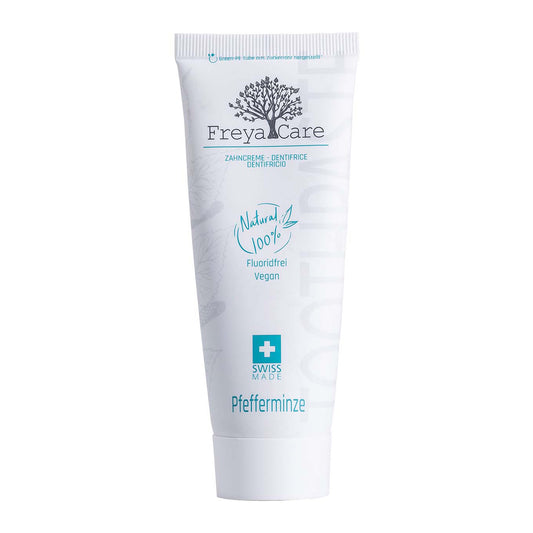
🦷 Why Freyacare works without fluoride, titanium dioxide, surfactants & glycerin
Natural. Alkaline. Scientifically conceived.
At Freyacare, you should know exactly what goes into your dental care products – and why.
Therefore, we consistently avoid fluoride, titanium dioxide, aggressive surfactants (e.g. SLS/SLES) and glycerin.
Instead, we rely on xylitol, magnesium carbonate, diatomaceous earth, peppermint and sage oil – in an alkaline formulation with pH ≈ 9.3, which naturally protects your teeth and supports remineralization.
Why without fluoride?
Classic studies have shown that fluoride can slow down tooth decay.
At the same time, some of it is swallowed during tooth brushing and stored in the body.
Excessive intake can lead to dental fluorosis, and recent studies discuss possible systemic effects.
A Harvard meta-analysis (Choi et al., 2012) showed evidence of neurotoxic effects at high fluoride exposure; Bashash et al. (JAMA Pediatrics, 2019) also found associations at lower doses.
Freyacare is deliberately taking a different approach here:
We use xylitol, magnesium carbonate and diatomaceous earth – active ingredients that create a naturally alkaline environment, inhibit bacteria and support the tooth surface – completely without fluoride.
Why without titanium dioxide (E171)
Titanium dioxide is used as a white pigment in many conventional toothpastes.
The European Food Safety Authority (EFSA) classified E171 as no longer safe in 2021 due to suspected nanoparticles that damage DNA.
Titanium dioxide has been banned in food since 2022 – but is still allowed in toothpaste.
We're playing it safe:
👉 No white pigment. No risk. No titanium dioxide.
Our toothpaste remains naturally bright and contains no synthetic coloring or glossing agents.
Why without surfactants (e.g., SLS, SLES)?
Foam does not automatically mean cleanliness.
Surfactants such as Sodium Lauryl Sulfate (SLS) and Sodium Laureth Sulfate (SLES) can irritate the oral mucosa and are associated with more frequent aphthous ulcers (Herlofson & Barkvoll, 1996).
We deliberately avoid such substances.
Instead, we clean gently – using fine diatomaceous earth particles and the natural power of essential oils.
This keeps your mouth clean without putting a strain on the mucous membrane.
Why without glycerin?
Glycerin is used as a humectant in many toothpastes.
Although it is plant-based, there is evidence that it leaves an invisible film on the tooth surface which can hinder remineralization (Weston Price Foundation Review 2018).
We therefore completely avoid using glycerin – so that your teeth can breathe freely and minerals can be re-deposited.
Magnesium carbonate + high pH = natural remineralization
The acquired enamel pellicle (AEP) is a thin, natural protective layer that surrounds your teeth.
It protects against acid attacks, regulates ion currents and plays an important role in remineralization.
What studies show
A basic pH (from ≈ 8–9) shifts the equilibrium away from demineralization towards the deposition of calcium and phosphate ions on the surface.
Magnesium ions (e.g. from magnesium carbonate) can be incorporated into the crystal structure of tooth enamel and improve its hardness and stability (PubMed 32891873 – 2020).
Magnesium-containing systems – such as Mg/Ca complexes or Mg-doped hydroxyapatites – show positive remineralization effects in laboratory studies (PMC 7152941, 2020).
These findings suggest that a combination of alkaline pH + available magnesium ions can promote the natural repair capacity of tooth enamel.
> An exact clinical study with the formulation "Magnesium carbonate at pH ≈ 9 directly regenerates the pelicles" does not yet exist.
However, research plausibly supports the idea that an alkaline environment + minerals positively influence the protective layer and remineralization.
What this means for you
Our alkaline formula with pH ≈ 9.3, magnesium carbonate, diatomaceous earth and xylitol creates optimal conditions:
– less acid stress
– more mineral offerings
– a healthy environment for the natural remineralization of your teeth.
Studies on xylitol – natural support for your teeth
In short: Xylitol can measurably reduce the risk of tooth decay and plaque bacteria.
The effect is best documented in studies on chewing gum and lozenges; for toothpaste, a large review shows a significant additional benefit when it contains approximately 10% xylitol.
Cochrane review (children, 10 studies):
Toothpaste containing 10% xylitol reduced caries by approximately 13% over 2.5–3 years compared to the same fluoride toothpaste without xylitol (Riley et al., 2015).
Janakiram et al. (2017):
Systematic meta-analysis shows a significant reduction in carious surfaces and a decrease in Streptococcus mutans.
Belize long-term study:
100% xylitol chewing gum showed the lowest caries risk (relative risk ≈ 0.27) with a sustained “carry-over effect”.
Turku Sugar Studies (adults):
Replacing sugar with xylitol led to a massive reduction in tooth decay because xylitol is hardly utilized by plaque bacteria and reduces acid production.
Söderling Review:
Shows that xylitol disrupts the adhesion of cariogenic bacteria and has a positive effect on the microbiome.
What this means for you:
Regular exposure to xylitol (several grams per day) can reduce plaque bacteria and slow down the formation of caries.
In toothpastes, xylitol works best in combination with an alkaline pH, magnesium carbonate and gentle mechanics – as with Freyacare.
Essential oils with effects
Peppermint oil and sage oil have natural antibacterial, anti-inflammatory and refreshing properties.
They support the oral microbiome and ensure a clean, long-lasting fresh feeling – without synthetic additives.
🌿 Conclusion
Freyacare stands for modern, natural dental care with a scientific basis:
✅ Fluoride-free
✅ Titanium dioxide free
✅ SLS/SLES free
✅ Glycerin-free
✅ Basic (pH ≈ 9.3)
✅ With xylitol & magnesium carbonate
✅ Vegan, without microplastics, without nanoparticles
This is how you support your oral health with the power of nature – gently, alkaline and scientifically plausible.
📚 Sources (selection)
Fluoride:
1. Marinho VCC et al. Cochrane Database Syst Rev. 2013 – “Fluoride toothpastes for preventing dental caries”
2. Choi AL et al. Environmental Health Perspective. 2012 – “Developmental Fluoride Neurotoxicity”
3. Bashash M et al. JAMA Pediatrics. 2019 – “Prenatal Fluoride Exposure and Cognitive Outcomes”
Titanium dioxide:
4th EFSA Panel 2021 – “Safety assessment of titanium dioxide (E171)”
Surfactants:
5. Herlofson & Barkvoll 1996 – Acta Odontol Scand. “SLS and recurrent aphthous ulcers”
Glycerin:
6. Weston Price Foundation Review 2018 – “Glycerin and tooth remineralization”
Magnesium & pH:
7. PubMed 32891873 (2020) – “Mg incorporation increases enamel hardness”
8. PMC 7152941 (2020) – “Remineralization effect of Mg-/Ca-gel complexes”
Xylitol:
9. Riley P et al. Cochrane Review 2015 – “Xylitol-containing products for preventing dental caries”
10. Janakiram C et al. J Nat Sci Biol Med. 2017 – “Xylitol in preventing dental caries”
11. Söderling E et al. Adv Dent Res 2009 – “Mechanism of action of xylitol on oral flora”
12. Makinen KK et al. J Dent Res 1995 – “Turku Sugar Studies – long-term xylitol use”
13. Milgrom P et al. Community Dent Oral Epidemiol 2006 – “Xylitol gum in Belize children”
Essential oils:
14. Kozak W et al. Molecules 2022 – “Natural essential oils as antimicrobial and anti-inflammatory agents in oral health”